You can import deals into Positive User from a CSV or XLSX file to populate your sales pipeline faster and more efficiently. This eliminates the need for manual data entry and ensures your CRM stays organized with structured deal information. In this article, you’ll learn how to prepare your file and map your stages to import deals correctly.
Before you begin, make sure your file is properly structured and that you understand how data is stored in Positive User. The platform uses both standard attributes (built-in fields such as email address or phone number) and custom attributes (fields you create yourself).
Create Pipelines: Each deal must be imported to a specific stage of the pipeline. To create a pipeline go to “Settings” → “Workspace Settings” → “Sales” → “Pipelines”. More info.
Match Standard Attributes: If your spreadsheet columns match standard attributes, you can import the file immediately.
Create Custom Attributes: If you want to include additional information that is not supported by default, you will need to create the relevant custom attributes first. Follow the steps in “How to Create a Custom Attribute“.
Verify Data Types: Make sure that each column has the correct attribute value type. For example, if you want to import "Scoring", make sure your attribute is an integer. If you want to import a "Date", set the attribute as datetime. Refer to “What Is an Attribute” for details on specific data types.
Before uploading, ensure your file is formatted correctly. If you aren't sure how your file should look, you can download a ready-to-use template directly from the app by clicking the “xlsx” or “csv” button in the “Data” → “Import” section.
To find more tips about data formatting, check our dedicated article.
Required Fields
You must have a unique identifier for each deal. This can be either a name or deal ID. You can have several deals with the same name but with different deal IDs.

The file must include the following columns:
name / deal_id (unique identifier of the deal)
stage (id of a specific stage of a specific pipeline deal is assigned to)
status (1 - in progress / 2 - won / 3 - lost / 4 - archived)
value (numeric estimation of the deal value)
currency (e.g. USD, PL, EUR)
Additional (recommended) columns:
person (contact_id of the contact you want to assign deal to)
company ID (if you want to assign a deal to a B2B prospect)
assigned to (first and last name of the team member responsible for the deal)
+ your custom attributes created in the app in prior
Column Headings
Always include column headings in the first row of your file. Try to give your columns exactly the same names as the existing in Positive User attributes have. If the column name is identical to the attribute name, the system will match them automatically during import.
Encoding
What is encoding? Encoding tells the computer how to interpret the text characters in your file. The default and most highly recommended format is UTF-8. Choosing UTF-8 ensures that special characters, accents, and symbols are imported correctly without turning into random symbols.
Separator
What is a separator? In CSV (Comma Separated Values) files, a separator is the punctuation mark used to divide your text into distinct spreadsheet columns. Common separators are commas (,) or semicolons (;).
Multi-value Fields
If one column contains multiple values (for example, “Tags” or any attribute with the fixed choice type with multiple values allowed), separate them using the pipe character: “|”
Example: tag1|tag2|tag3
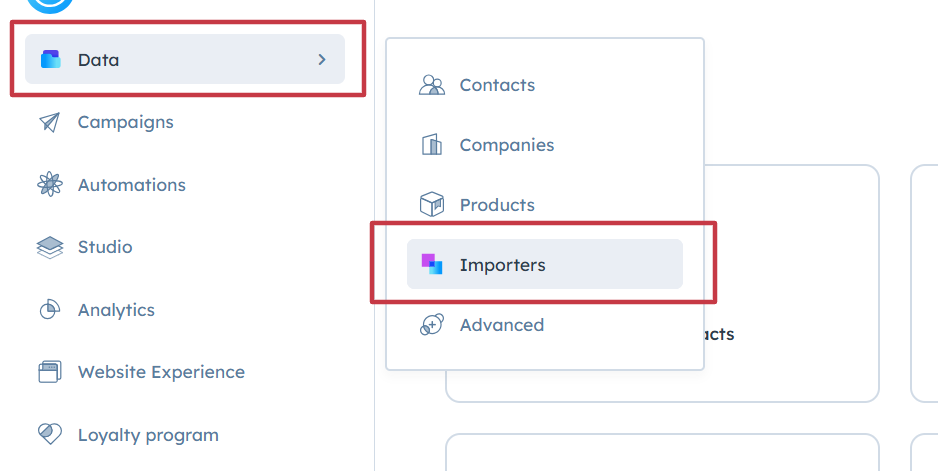
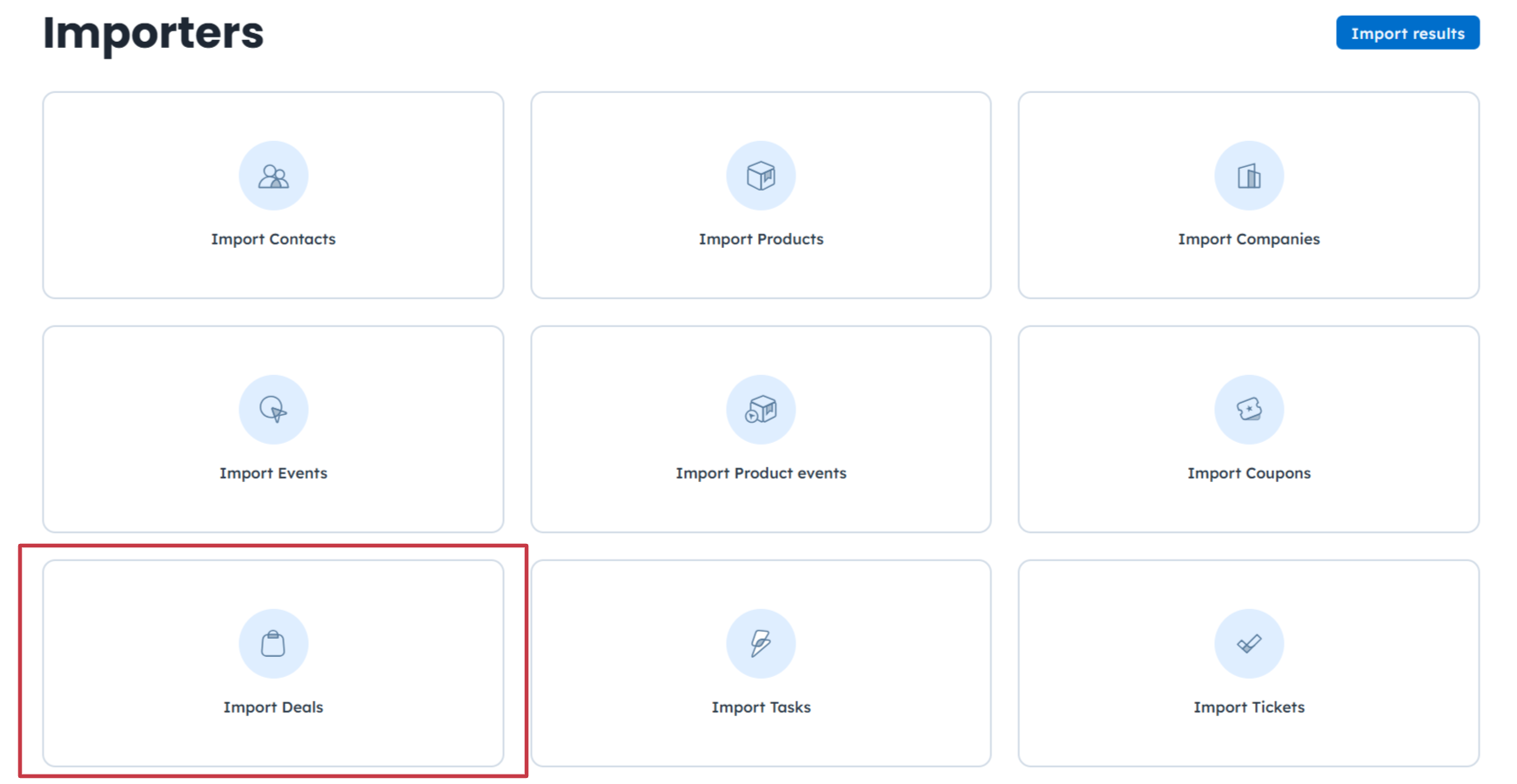
Go to “Data” → “Importers” and choose “Import Deals”.
OR
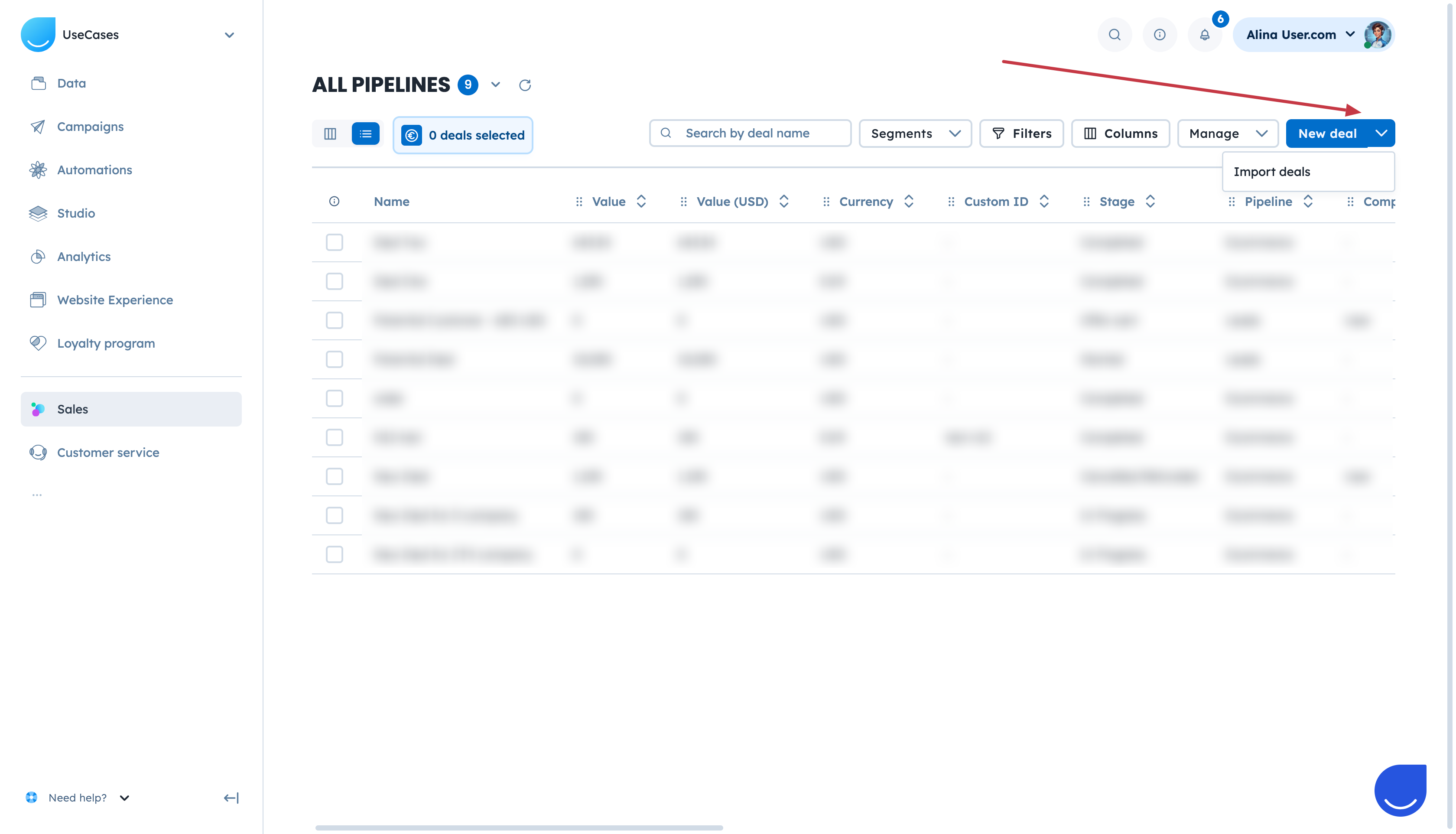
Go to “Sales” → “Deals” section and find an arrow button near “New deal”. Then go with “Import deals”.
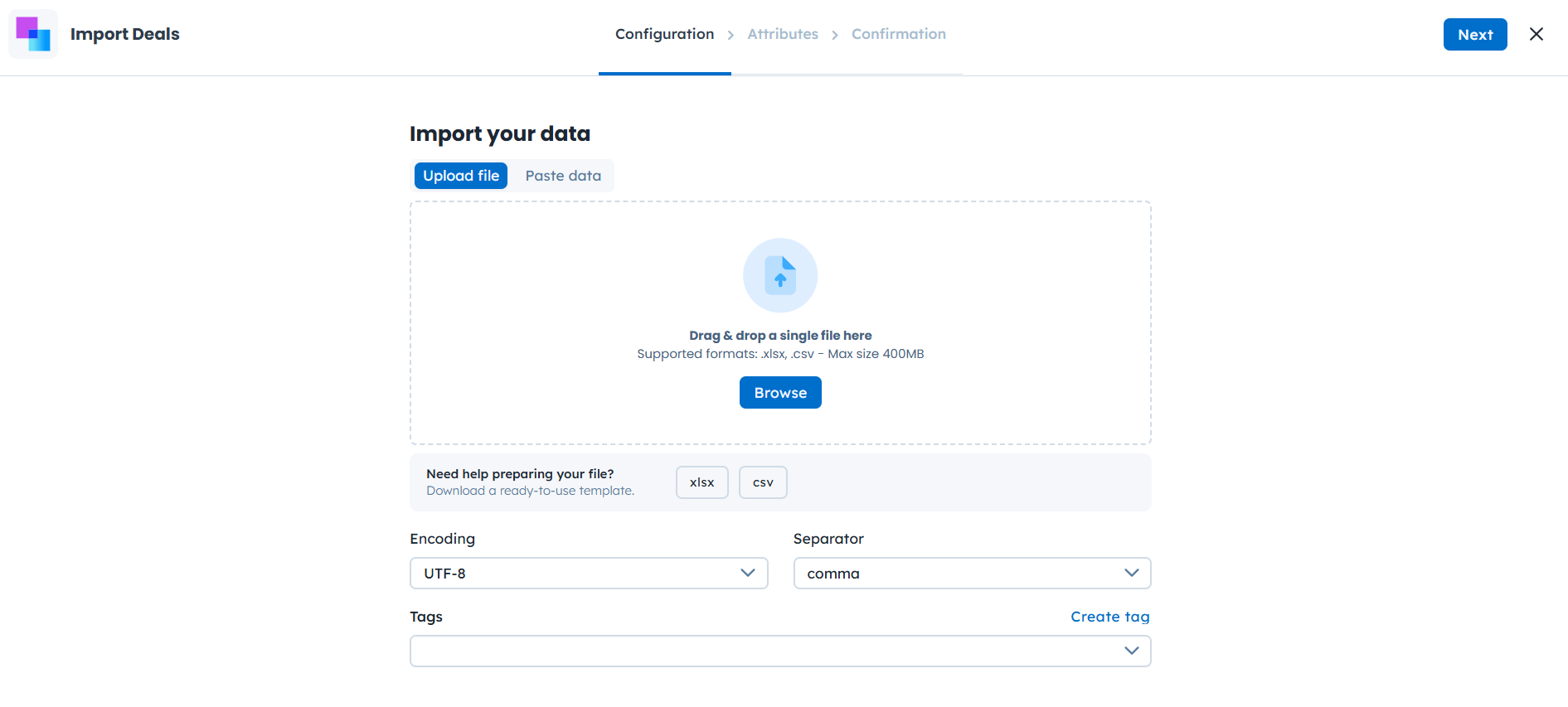
Upload or drag&drop the file.
Choose the encoding to be suitable to your file. (UTF-8 is a default one)
Choose the separator used in your file.
Add tags if you want them to be applied to the deals.
This step is about mapping the column headers from your file to the existing attributes in Positive User.
Auto-matching: If the name of the column in your file is exactly the same as the attribute name in the system, they will be matched automatically.
Manual matching: For unmatched columns, simply select the correct existing attribute from the drop-down menu to connect them.
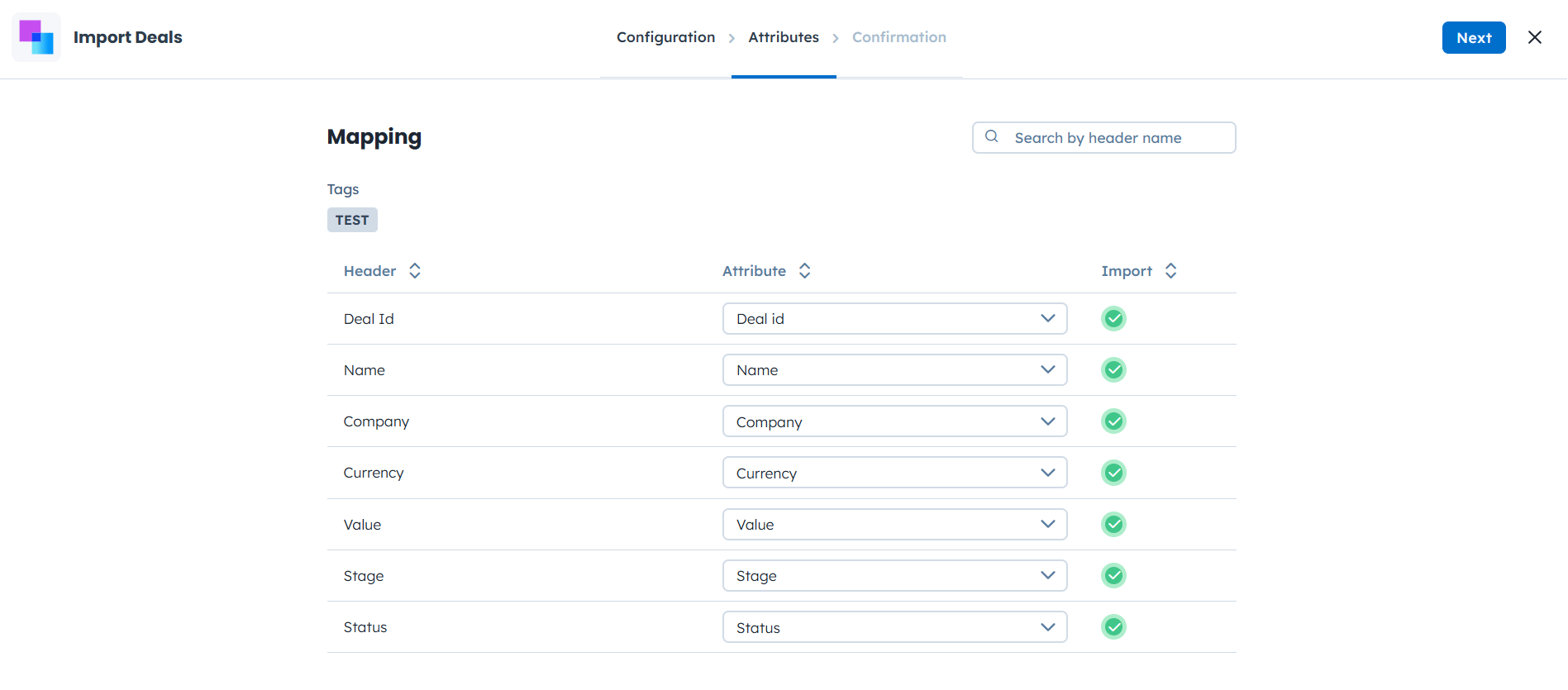
Once all the columns from your file are matched with attributes, click “Next”. You will be redirected to the “Confirmation” step.
In the “Confirmation” step, you review the summary of the import and confirm the process. After confirmation, the system starts processing your file.
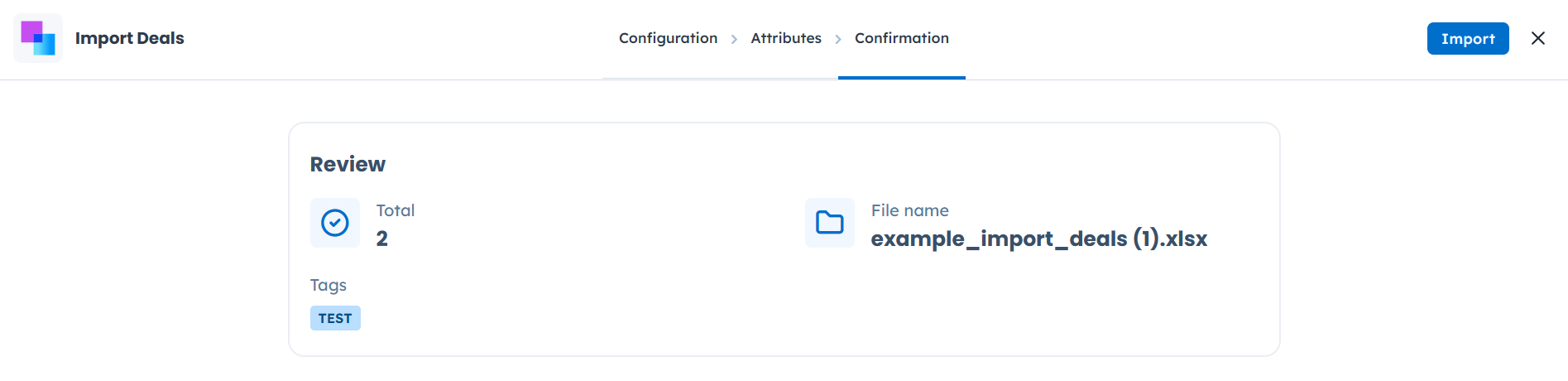
You can monitor the import process and check the final results in the “Import Results” section, where you are redirected automatically.
You can visit this section any time via “Data” → “Importers” → “Import Results” path.
Here you will see:
Import status (Started/Pending/Complete/Archived)
Date created
Completed at
Type (what kind of data was imported)
Created by (team member who uploaded the file)
File name
Total rows (from your file)
Succeeded (final number of rows imported)
Failed (shows number of failures)
To view the newly imported profiles, go to “Sales” → “Deals”→ table view. You can filter your deals by the specific attributes or tag you attached during the import to easily review the imported data.
You can use the same import process to update existing deals. To update a deal, the system must recognize it by:
name
OR
deal_id